Kainchi Dham Has Become a Pilgrimage Giant. Its Roads Haven’t.
There is something unusual happening around Kainchi Dham these days.
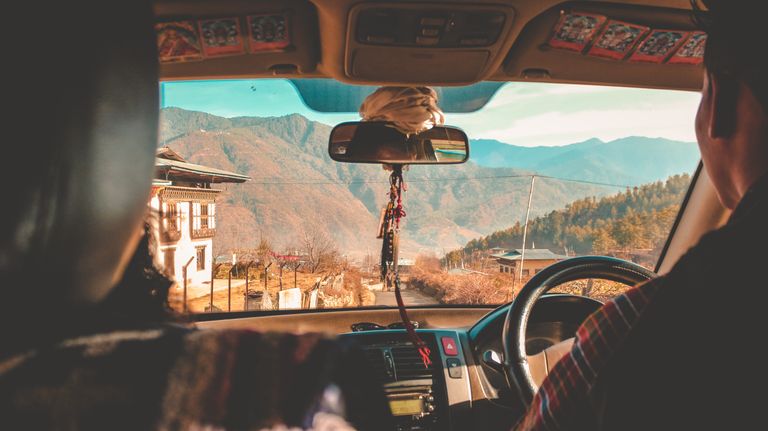
Every weekend, the road towards the small hill town of Kainchi seems to carry more people than the last. Cars with families from Delhi, taxis from Haldwani, buses full of devotees, and two-wheelers heading towards the ashram all converge on the same mountain roads.
For many of these visitors, it is a deeply meaningful journey.
For some, it is their first visit after discovering Neem Karoli Baba through Instagram, YouTube, or a film. For others, it is a long-awaited pilgrimage they have been planning for months.
And then there are the people who live here.
For them, the road to Kainchi Dham isn’t a pilgrimage route. It is simply the road they use to go to work, school, the market, a hospital, or Haldwani.
That difference is becoming increasingly difficult to ignore.
On October 2, 2026, more than 35,000 vehicles reportedly entered the Nainital–Bhowali–Bhimtal–Kainchi corridor during the long weekend. The following day, authorities had to restrict uphill traffic from Haldwani and Kathgodam as the pressure on the roads increased.
For someone visiting from another city, getting stuck for several hours might ruin a weekend.
For someone who lives here, it can disrupt everyday life.
And that is the side of Kainchi Dham’s growing popularity that deserves more attention.
How did Kainchi Dham become so crowded?
Kainchi Dham has been a place of pilgrimage for decades.
Neem Karoli Baba’s followers have been coming here long before Instagram, YouTube, and travel influencers existed. The ashram has a history that reaches far beyond the current tourism boom.
But the way people are discovering the place has changed completely.
A young person today may first hear about Neem Karoli Baba from a reel.
Someone else may come across a YouTube video talking about Steve Jobs’ connection with the Baba.
Another person may discover his teachings through Ram Dass.
And this year, many people have been introduced to his story through the film Hanuman Ansh.
The discovery happens online.
The visit happens in the real world.
And sometimes the gap between the two is only a few days.
That is one of the reasons the current wave feels different from the pilgrimage culture that existed here earlier.
The numbers are difficult to ignore
There is a temptation to say that Kainchi Dham is simply “more crowded than before.”
The numbers tell a much bigger story.
According to figures reported from the district statistics department and temple CCTV data, more than 19 lakh devotees visited Kainchi Dham between August 2025 and January 2026.
To understand what that means, consider that the shrine had previously been reported to receive around 2–3 lakh visitors in an entire year.
Recent reports have also described days when 15,000–20,000 people arrived, with one September day reportedly seeing more than 30,000 devotees.
Then came the October long weekend, when more than 35,000 vehicles were reported in the wider tourist corridor.
None of these numbers should be treated as exactly comparable because they measure different things—visitors, daily footfall and vehicles.
But together they make one thing clear:
Kainchi Dham is no longer dealing with occasional pilgrimage crowds. It has become a major mass-tourism destination.
And the roads around it are having to deal with that reality.
The road isn’t only used by pilgrims
This is probably the most important part of the conversation.
When you see pictures of Kainchi Dham on social media, it is easy to think of the road as part of the pilgrimage experience.
But for people living in the surrounding villages, that road is just… the road.
It takes them to Bhowali.
It connects them towards Haldwani.
It is used by buses, taxis, delivery vehicles, and people who are travelling for work.
A child might use it to get to school.
A family might use it to visit a doctor.
Someone might need to reach Haldwani for a train.
A shopkeeper might be waiting for a supplier.
None of these people are travelling to Kainchi Dham.
But when thousands of visitors arrive at the same time, they get caught in the same traffic.
That is where the problem becomes bigger than a traffic jam outside a temple.
It becomes a problem of everyday mobility.
Imagine needing to reach Haldwani on one of these weekends.
This is something that is easy to overlook if you are visiting from outside Uttarakhand.
You arrive in your car.
You see the traffic.
You complain about the traffic.
Eventually, you get through it and continue your journey.
But imagine this is your normal route home.
Imagine you have an appointment in Haldwani.
Imagine you have to catch a train.
Imagine your child has an exam.
Or imagine someone in your family needs medical attention.
You can’t simply decide to wait until the tourists have gone home.
You have somewhere you need to be.
Recent October reporting described travelers being stuck for hours, with some journeys that normally take five or six hours stretching to 12–14 hours during severe congestion.
At that point, calling it “holiday traffic” doesn’t really describe what is happening.
And then there is the ambulance problem
The most worrying part of the Kainchi Dham traffic situation is what happens when someone needs medical help.
This is no longer just a hypothetical concern. In June 2025, a 40-year-old man from Nainital district, Jagmohan Singh Pinari, died while being transported towards Haldwani. His family first called a government ambulance, but that vehicle reportedly broke down. The family then arranged another ambulance, which became stuck in the severe traffic near Kainchi Dham. According to reports, a journey that would normally take around two hours eventually took nearly five hours, and the patient was declared dead after reaching Haldwani. The Nainital district administration ordered an inquiry into the circumstances surrounding the ambulance response and the traffic delay.
That incident happened in 2025, but what is happening around Kainchi Dham in October 2026 suggests that the underlying problem has not disappeared.
On October 4, Aaj Tak reported that the latest weekend traffic chaos was affecting ambulances as well as people travelling with essential supplies. The report described stretches of the Kainchi Dham route where journeys that would normally take a few hours were taking 11–12 hours, with patients, elderly travellers, and emergency vehicles among those caught in the congestion.
The administration itself appears to recognize the seriousness of the problem. For the October 2–4 weekend, when a large tourist and pilgrimage rush was expected, police announced a special traffic plan that included a dedicated green corridor for ambulances, fire tenders, police vehicles, and other emergency services.
That detail is important.
When a traffic plan has to specifically create an emergency corridor because of the expected pilgrimage rush, it tells us that the situation is no longer simply a matter of tourists losing a few hours in traffic. Emergency access has become an infrastructure issue.
One cannot say that every medical emergency delayed by traffic would have had a different outcome. That would be impossible to establish without medical evidence. But an ambulance stuck in a queue for hours is still a serious warning sign. Emergency services work on minutes, not on whether the traffic will clear after the weekend crowd has moved.
And this is where the Kainchi Dham discussion becomes much bigger than tourism.
A visitor can eventually turn around, wait or change their travel plans. A patient cannot always do that.
The green corridor question
The decision to create an emergency green corridor during the October weekend is a welcome step, but it also raises a larger question: why should emergency access depend on a special weekend traffic plan at all?
Kainchi Dham’s busiest days are no longer difficult to predict. Weekends, public holidays and major events regularly bring large numbers of visitors. That means emergency access should be built into the permanent design of the route rather than activated only when authorities expect an unusually large crowd.
An ambulance should not have to compete with tourist cars for road space. There should be a system that allows emergency vehicles to move through the corridor even when traffic is moving at a crawl. Whether that comes through a permanently protected lane, controlled intersections, rapid-response traffic teams or another solution suited to the geography of the area, the principle should remain the same: a pilgrimage destination cannot function properly if an ambulance has no reliable way through it.
There is another side to the story
It would be unfair to pretend that the Kainchi Dham boom is bad for everyone.
It isn’t.
There are local people who are benefiting from the increase in visitors.
Hotels are fuller.
Homestays have more guests.
Restaurants have more customers.
Taxi drivers have more bookings.
Small shops and vendors get more business.
For a region that depends heavily on tourism, more visitors can mean more income and more opportunities.
That is why I don’t think the answer is to tell people to stop visiting Kainchi Dham.
The destination is popular for a reason.
People want to come.
And local businesses should be able to benefit from that.
The problem is what happens when the number of people arriving grows much faster than the infrastructure supporting them.
Uttarakhand has already identified the problem
Interestingly, this isn’t a problem nobody saw coming.
The Uttarakhand Tourism Department has already carried out a carrying-capacity assessment around Kainchi Dham, Bhowali and Nainital.
The study estimated that Kainchi Dham could see around 11,000 visitors on busy days, compared with approximately 2,000–3,000 on quieter days.
More importantly, 74% of surveyed visitors were dissatisfied with parking facilities.
That number tells us something very simple.
The parking problem isn’t just a local complaint.
Even visitors themselves are experiencing it.
The study also found that 82.4% of visitors were from outside Uttarakhand and 59.4% were visiting Kainchi Dham for the first time.
That suggests the destination’s audience is changing.
More people are discovering it from outside the state.
And many of them are first-time visitors.
So there is a good chance that the demand we are seeing now isn’t going to disappear anytime soon.
Social media has changed pilgrimage
There was a time when a place like Kainchi Dham grew through families and communities.
Someone would visit.
They would return home.
They would tell their relatives.
Eventually, another family would make the journey.
Today, the process is much faster.
A single Instagram Reel can introduce Kainchi Dham to hundreds of thousands of people.
A YouTube video can continue bringing visitors years after it is uploaded.
A celebrity visit can create another wave of interest.
And a successful movie can take the story of Neem Karoli Baba to an audience that may never have heard of him before.
That appears to be happening again in 2026.
The release and success of Hanuman Ansh has brought renewed attention to Neem Karoli Baba, with recent reporting connecting the film’s popularity with increased interest in visiting Kainchi Dham.
In some ways, it is a beautiful example of how a spiritual tradition can reach a new generation.
But there is a practical problem.
Social media can send 10,000 people to a place much faster than a government can build a parking lot for 10,000 cars.
That is the gap Uttarakhand now has to deal with.
Kainchi Dham needs a better way to handle visitors
The solution doesn’t have to be complicated.
But it does need to be planned before the next major weekend arrives.
One obvious step would be to make park-and-shuttle systems much more effective.
Instead of allowing thousands of private vehicles to travel as close to the ashram as possible, visitors could leave their cars at larger parking areas in suitable locations and continue by shuttle.
This would also make the experience easier for visitors.
Nobody really wants to spend half their pilgrimage looking for a place to park.
The administration has already experimented with parking and shuttle arrangements during busy periods. The challenge now is making such systems reliable enough that visitors actually choose them.
What about local residents?
This is where I think any future plan needs to be different.
A traffic plan shouldn’t only ask:
“How do we get tourists to Kainchi Dham?”
It should also ask:
“How do we make sure residents can still move through the region?”
That means keeping local routes accessible where possible.
It means ensuring public buses can continue operating.
It means protecting access for emergency vehicles.
And it means understanding that not every person stuck in the traffic is a tourist.
Somebody sitting in the next car may simply be trying to get home.
Maybe the answer is not fewer visitors, but fewer cars
This is probably the most important distinction.
Suppose 10,000 additional people want to visit Kainchi Dham.
That doesn’t necessarily mean the road needs to handle 10,000 additional private vehicles.
If a significant portion of those people arrive through buses, shuttles or shared transport, the pressure on the road could be very different.
That is where Uttarakhand has an opportunity.
Instead of thinking only about how many people the destination can accommodate, authorities should also think about how those people arrive.
The same number of pilgrims can create very different levels of congestion depending on the transportation system.
Weekends are the real challenge
There is also a simple way to reduce some of the pressure: encourage people to visit on weekdays.
The current pattern is understandable.
People work during the week.
They have Saturday and Sunday free.
So they travel.
But when almost everyone chooses the same two days, the road network gets hit at the same time.
A simple live visitor-information system could help.
Before leaving Haldwani, a traveller could see:
Current Kainchi Dham crowd: High
Parking availability: Limited
Traffic: Heavy
Recommended option: Park at designated location and use shuttle
That would be far more useful than finding out about the traffic only after entering the queue.
There should always be room for an ambulance
If there is one thing that should never be compromised, it is emergency access.
On the busiest weekends, authorities should have a clearly defined emergency corridor and a system for immediately clearing it whenever an ambulance, fire vehicle or other emergency service needs to pass.
This shouldn’t depend on drivers being polite enough to move.
It shouldn’t depend on a police officer finding a way through a traffic jam.
It should be part of the design.
Because nobody should have to ask whether an ambulance can make it through Kainchi traffic.
Kainchi Dham is changing—and that isn’t necessarily bad
There is a tendency to romanticise the past and complain about everything that changes.
That would be unfair too.
Kainchi Dham is attracting a new generation.
People who may never have known about Neem Karoli Baba are discovering his teachings.
Visitors from different parts of India are coming to Kumaon.
Local businesses are seeing new customers.
The region is receiving attention.
There is something genuinely positive about that.
The problem is not that Kainchi Dham is becoming popular.
The problem is that its popularity has grown incredibly quickly.
And when growth happens faster than infrastructure, somebody eventually pays the cost.
Right now, that cost is increasingly visible on the roads.
A pilgrimage destination should not become a burden on the people who live there
This is perhaps the heart of the issue.
Nobody should have to choose between tourism and local life.
It should be possible for both to exist.
Visitors should be able to come to Kainchi Dham.
They should be able to pray.
They should be able to stay in local hotels.
They should be able to eat at local restaurants.
They should be able to spend money in local shops.
And local residents should still be able to reach Haldwani.
They should still be able to take their children to school.
They should still be able to get to work.
And if someone needs an ambulance, it should be able to move.
That shouldn’t be too much to ask.
Kainchi Dham doesn’t need fewer devotees. It needs better planning.
The popularity of Kainchi Dham is not going away anytime soon.
If anything, the combination of social media, films, domestic tourism and renewed interest in Neem Karoli Baba could bring even more visitors in the coming years.
So the question isn’t whether the crowds will disappear.
The better question is whether the infrastructure will catch up.
More parking.
Better shuttle services.
Real-time traffic information.
Protected emergency access.
Better public transportation.
Weekend crowd management.
And, most importantly, a plan that considers the people who already live here.
Kainchi Dham has become much more than a small ashram beside a mountain road.
It has become one of Uttarakhand’s most important pilgrimage destinations.
That growth can be good for the region.
But it needs to be managed carefully.
Because the people coming to Kainchi Dham are looking for peace.
And the people who live there deserve some peace too.
There was a time when a visit to Kainchi Dham was largely a spiritual journey.
People came to the hills, stood quietly in the queue, offered prayers at Neem Karoli Baba’s ashram and returned home.
Today, Kainchi Dham is something much bigger.
It has become one of the most talked-about spiritual destinations in India. Young people are discovering Neem Karoli Baba through social media, stories about Steve Jobs and other prominent followers continue to circulate, celebrities have visited the ashram, and the 2026 film Hanuman Ansh has introduced Baba’s story to an even wider audience.
The result is visible every weekend.
The roads around Kainchi, Bhowali and Bhimtal are increasingly crowded with private cars, taxis, buses and tourist vehicles. On some days, the traffic is no longer simply inconvenient. It becomes a serious problem for people trying to travel through the region for work, education, medical treatment or everyday necessities.
And that raises an uncomfortable question:
Can a place become so popular that its popularity starts hurting the people who call it home?
Kainchi Dham’s popularity has exploded
The scale of the growth is difficult to ignore.
According to figures reported from the district’s statistics department and temple CCTV data, more than 19 lakh devotees visited Kainchi Dham between August 2025 and January 2026 alone. Earlier, the shrine reportedly received around 2–3 lakh visitors in an entire year.
A separate carrying-capacity assessment conducted by the Uttarakhand Tourism Department found that Kainchi Dham could see around 11,000 visitors on busy days, compared with approximately 2,000–3,000 on quieter days. The study also found that 59.4% of visitors were visiting for the first time and 82.4% were from outside Uttarakhand.
More recent reporting suggests that the numbers have climbed even further.
On busy weekends, reports have put daily footfall at approximately 15,000–20,000 devotees, compared with around 4,000–5,000 previously.
Another report in September documented more than 30,000 devotees in a single day, accompanied by several hours of slow-moving traffic on the highway.
And then came the October long weekend.
On October 2, more than 35,000 vehicles moved towards the Nainital–Bhowali–Bhimtal corridor, putting enormous pressure on the road network. Authorities subsequently had to restrict traffic heading uphill from Haldwani and Kathgodam during evening hours.
These numbers tell us something important.
This is no longer occasional pilgrimage traffic. It is becoming a permanent infrastructure challenge.
Why is everyone suddenly visiting Kainchi Dham?
The growth did not happen because of one single reason.
Neem Karoli Baba already had a strong following in India and abroad. His association with spiritual seekers such as Ram Dass helped introduce his teachings to audiences outside India decades ago.
Later, stories connecting Baba with figures from the technology world — including Steve Jobs and Mark Zuckerberg — brought a completely different generation of attention to Kainchi Dham.
But 2026 appears to have created another major wave.
The Hanuman Ansh effect
The release of Hanuman Ansh, a film based on the life of Neem Karoli Baba, has brought his story to millions of people who may never previously have considered visiting Kainchi Dham.
The film became a major box-office success and reporting in September and October linked its popularity with a renewed rush towards the ashram.
One particularly interesting example came from a visitor interviewed by The Indian Express. He said he watched the film, booked a ticket almost immediately and travelled to Kainchi Dham.
That is a completely different tourism cycle from the traditional pilgrimage model.
Watch a film → discover Baba → search Kainchi Dham online → see Instagram/Reels content → plan a weekend trip → visit.
Social media then amplifies the cycle.
A destination that once spread largely through word of mouth can now reach millions of potential visitors within days.
That is wonderful for the popularity of the place.
But roads do not go viral.
Parking lots do not scale overnight.
And mountain highways cannot suddenly become wider because Instagram has discovered a destination.
The biggest problem is not the temple. It is the road.
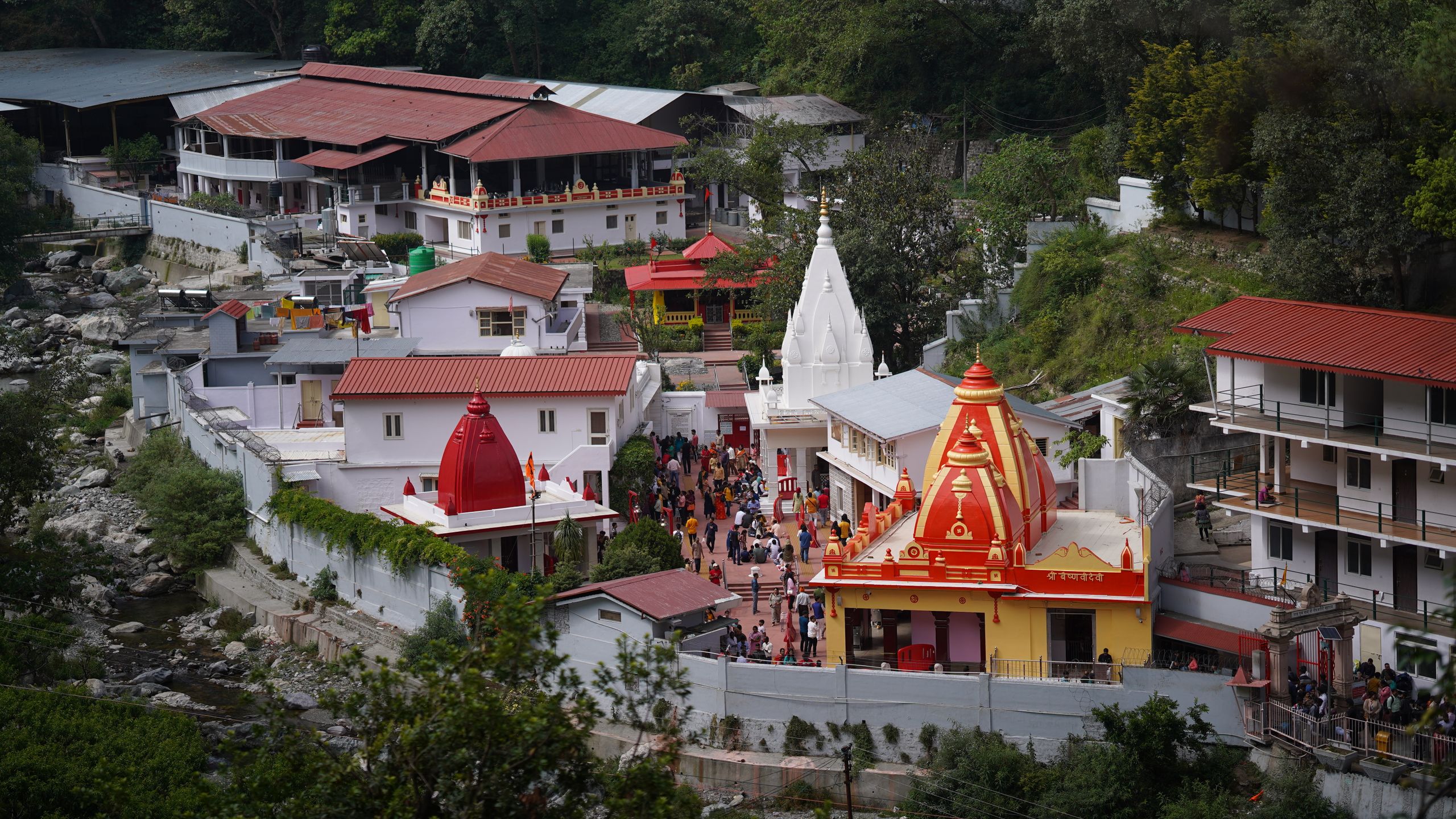
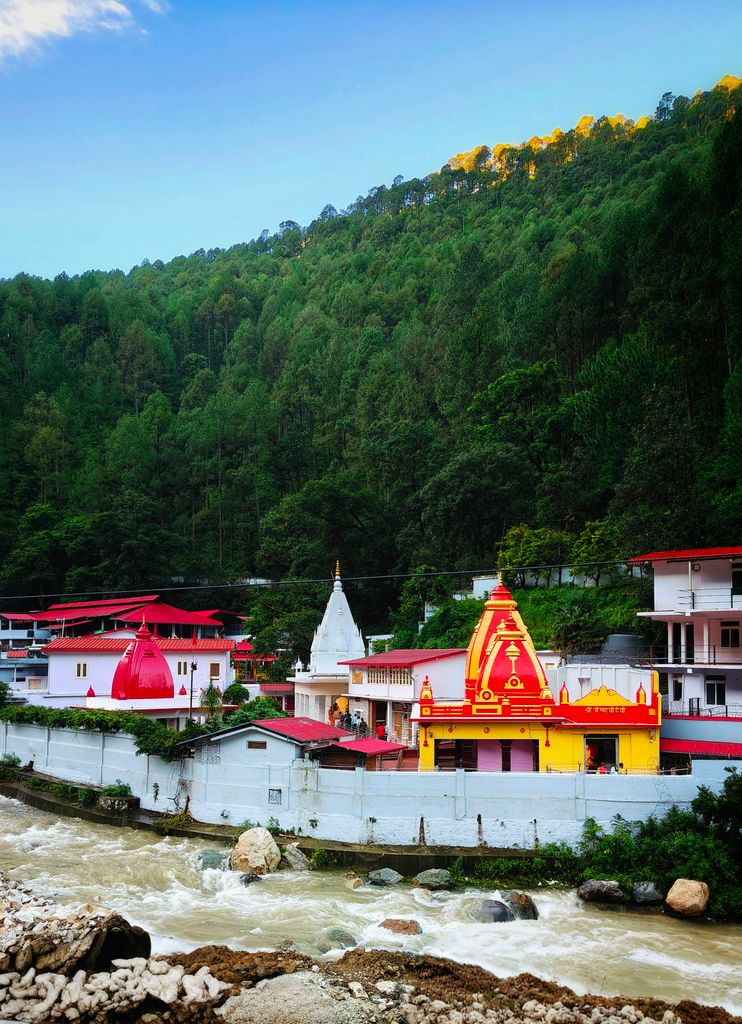
Kainchi Dham itself is a relatively small spiritual centre located on the Nainital–Almora road.
The official Nainital district website describes Kainchi Dham as being approximately 9 km from Bhowali and 17 km from Nainital.
The surrounding road is therefore not just a tourist road.
It is part of a much larger transportation network connecting different parts of Kumaon.
That distinction matters.
For a tourist, a three-hour traffic delay may mean a frustrating holiday.
For a resident, the same three hours can mean missing work, missing school, missing an appointment or being unable to reach a hospital.
For a truck driver, it can mean delayed supplies.
For a passenger travelling between hill districts and Haldwani, it can turn a normal journey into an all-day ordeal.
And for an emergency vehicle, the consequences can be much more serious.
When a traffic jam becomes an emergency problem
This is perhaps the most worrying aspect of the situation.
In June 2025, a Nainital resident died after an ambulance carrying him became stuck in severe traffic near Kainchi Dham. According to The Times of India, the journey to Haldwani was significantly delayed, and the case triggered concerns over emergency response and traffic management in the region.
This incident should not be used to claim that every current traffic jam causes medical emergencies.
But it does demonstrate something important:
When a major road becomes chronically congested, emergency access becomes vulnerable.
Imagine living in one of the villages connected to this corridor.
Your family member suddenly needs to reach Haldwani for treatment.
You call an ambulance.
The ambulance arrives.
But then it enters a queue of hundreds or thousands of vehicles.
At that point, the problem is no longer about tourism.
It becomes a question of basic accessibility.
Recent reporting in October 2026 has again highlighted that ambulances, students, buses, local residents and commercial vehicles can become trapped in the congestion around Kainchi and Bhowali. One report described travellers being stuck for up to seven hours, with journeys that normally take five to six hours stretching to 12–14 hours.
The people living around Kainchi Dham are caught in the middle
There is an important side of this story that often gets lost.
Local people are not against devotees.
For many families, the growing popularity of Kainchi Dham is economically beneficial.
Hotels, homestays, restaurants, taxi operators, shops and local vendors all benefit from the increased movement of visitors. The tourism department’s own assessment recognised the economic activity generated by the shrine and surrounding destinations.
That is the positive side.
But economic benefit does not automatically cancel out infrastructure pressure.
A resident who needs to travel from a nearby village towards Haldwani does not necessarily have the option of waiting until the tourist rush disappears.
They have to travel when they need to travel.
A student has to attend an exam.
A worker has to reach work.
A patient has to reach a hospital.
A family has to buy groceries.
A truck has to deliver medicines, vegetables or other essential goods to the hills.
And when thousands of tourist vehicles occupy the same narrow corridor, everyone gets caught in the same queue.
Recent reporting has highlighted precisely this problem, with residents and everyday travellers describing major disruption to normal movement through the region.
This is why the weekend problem matters
There is now a pattern developing.
Weekdays can be manageable.
Then Friday arrives.
Saturday arrives.
Sunday arrives.
And suddenly the road becomes a pilgrimage corridor.
This is particularly problematic because Kainchi Dham is not isolated from the wider tourism network.
Visitors often combine their trip with:
- Nainital
- Bhimtal
- Bhowali
- Almora
- Mukteshwar
- Ranikhet
- Haldwani
- other Kumaon destinations
So a traffic problem at Kainchi can quickly spread beyond Kainchi.
A queue near the ashram can become a problem in Bhowali.
A blockage in Bhowali can affect Bhimtal.
Pressure on the highway can affect vehicles travelling between Haldwani and the hill districts.
That is why the latest traffic problems should not be viewed as a small local issue.
Kainchi Dham is sitting on a road that serves both pilgrims and the everyday economy of Kumaon.
Authorities are already trying to manage the pressure
To be fair, the administration has not ignored the problem.
Police have introduced weekend traffic and diversion plans, including parking vehicles at locations such as Bhimtal Vikas Bhawan and Bhowali Sanatorium and using shuttle services to transport devotees towards Kainchi Dham. Heavy vehicles have also been subject to diversion or restrictions depending on traffic conditions.
At different times, authorities have also restricted taxis and two-wheelers from entering the shrine area on weekends and encouraged visitors to use designated parking and shuttle arrangements.
These are useful measures.
But the recent October long weekend shows the limits of managing a rapidly growing crowd purely through traffic diversion.
On October 2, more than 35,000 vehicles entered the wider Nainital–Bhowali–Bhimtal–Kainchi corridor.
The next day, authorities had to introduce additional restrictions, including controlling uphill traffic from Haldwani and Kathgodam during evening hours.
That suggests the system is increasingly operating in reaction mode.
And that is the bigger issue.
Kainchi Dham needs a carrying-capacity approach, not just a traffic plan
Interestingly, the Uttarakhand government already recognised the problem before the current surge.
In 2025, the state began a tourist carrying-capacity assessment covering Kainchi Dham, Bhowali and Nainital. The objective was to understand how much tourism the region’s infrastructure could sustainably handle.
The assessment found major concerns around parking, sanitation and other visitor facilities.
For example, 74% of surveyed visitors were dissatisfied with parking facilities.
That finding is significant.
Because parking is not simply a convenience issue in a mountain destination.
If there is insufficient parking, vehicles spill onto roads.
If vehicles spill onto roads, traffic slows.
If traffic slows, queues grow.
If queues grow, local roads become inaccessible.
And once local roads are blocked, emergency response becomes more difficult.
It is a chain reaction.
So what should happen next?
The answer should not be to stop people from visiting Kainchi Dham.
That would be unfair to devotees and damaging to local businesses that depend on tourism.
The answer should be managed pilgrimage and tourism.
1. Create a proper vehicle-capacity system
Instead of allowing an unlimited number of private vehicles to enter the corridor and then trying to control the situation after congestion begins, authorities could monitor vehicle inflow in real time.
Once the sustainable threshold is reached, vehicles could be held at designated parking hubs in Haldwani, Bhowali, Bhimtal or other suitable locations.
2. Make shuttle transport the default on peak weekends
If thousands of people are coming specifically for darshan, there is little reason for every visitor to take a private vehicle all the way to Kainchi.
Large peripheral parking facilities combined with reliable, affordable shuttle buses could dramatically reduce the number of vehicles reaching the shrine.
3. Protect an emergency corridor
A clearly enforced emergency lane should remain available throughout the busiest periods.
Not a theoretical emergency lane.
A real one.
One that is physically protected from parked vehicles and congestion wherever possible.
Ambulances, fire services and other emergency vehicles should never have to negotiate through a wall of tourist traffic.
4. Separate local traffic from tourist traffic
The people who live in the region should not have to compete with weekend tourists for basic road access.
A traffic management system should identify local routes and protect essential movement wherever possible.
5. Spread visitors across the week
The current weekend concentration is one of the biggest problems.
Tourism campaigns and digital information could encourage visitors to consider weekdays and less crowded periods.
Even moving a fraction of weekend visitors to weekdays could make a meaningful difference.
6. Make the carrying-capacity data public
The government has already undertaken studies.
The next step should be transparency.
People should know:
- How many visitors can Kainchi Dham safely accommodate?
- How many vehicles can the surrounding road network handle?
- How much parking capacity exists?
- How many shuttle buses are available?
- What happens after capacity is reached?
- What is the emergency response plan?
Tourists deserve this information.
Local residents deserve it even more.
A pilgrimage destination should not become a burden on the people who live there
The growth of Kainchi Dham does not have to come at the expense of the people who live around it. Visitors should be able to come, pray, stay in local hotels, eat at nearby restaurants, and support the local economy. At the same time, residents should be able to continue their everyday lives without having to plan every journey around the weekend tourist rush. A person travelling to Haldwani for work, a student going to school, a family visiting a hospital, or a shopkeeper waiting for essential supplies should not have to compete with thousands of tourist vehicles simply because they happen to be travelling on the same road.
This is why the conversation around Kainchi Dham needs to move beyond whether tourism is good or bad. Tourism is clearly bringing economic opportunities to the region, and there is no reason those opportunities should disappear. The real challenge is finding a way to manage the growth so that visitors and residents can coexist. Better parking, reliable shuttle services, real-time traffic information, protected emergency access, and properly planned weekend traffic management could make a significant difference. The people who live in Kumaon should not have to choose between supporting tourism and being able to move freely through their own region.
Kainchi Dham is changing—and that isn’t necessarily bad
It is easy to look at the current crowds and wish that Kainchi Dham could return to a quieter time. But that would also mean ignoring something genuinely positive that is happening. A new generation is discovering Neem Karoli Baba, often through social media, films and stories shared online. People from across India, and increasingly from outside the country, are travelling to Kumaon to experience the ashram for themselves. Local hotels, homestays, restaurants, taxi operators and small businesses are benefiting from this increased attention, and the wider region has an opportunity to build a stronger tourism economy around it.
The popularity itself is not the problem. In fact, it can be seen as a sign that Kainchi Dham and the legacy of Neem Karoli Baba continue to have meaning for people decades later. The concern is that the growth has happened much faster than the infrastructure around the destination has been able to adapt. A small mountain road and limited parking facilities were never designed for the kind of visitor and vehicle numbers being seen today. If Kainchi Dham is going to continue attracting thousands of people every weekend, the planning around it has to evolve as well.
Kainchi Dham doesn’t need fewer devotees. It needs better planning.
The popularity of Kainchi Dham is unlikely to disappear anytime soon. If anything, the combination of social media, films, domestic tourism, and renewed interest in Neem Karoli Baba could bring even more visitors in the coming years. That makes the current traffic problems less of a temporary inconvenience and more of a warning about what the region could face if visitor numbers continue increasing without a long-term plan.
The answer does not have to be fewer devotees. It could simply mean fewer private cars reaching the busiest parts of the route, better shuttle connections, larger peripheral parking areas, real-time information about crowd and traffic conditions, stronger public transport, and a clearly protected route for emergency vehicles. Most importantly, future planning needs to include the people who already live here. Kainchi Dham has become much more than a small ashram beside a mountain road; it is now one of Uttarakhand’s major pilgrimage destinations. Its infrastructure needs to reflect that reality.
People travel to Kainchi Dham because they are looking for peace, faith, and a connection with Neem Karoli Baba. The people who live around Kainchi deserve the ability to find some peace in their everyday lives too. The challenge for Uttarakhand now is to make sure that one does not come at the cost of the other.